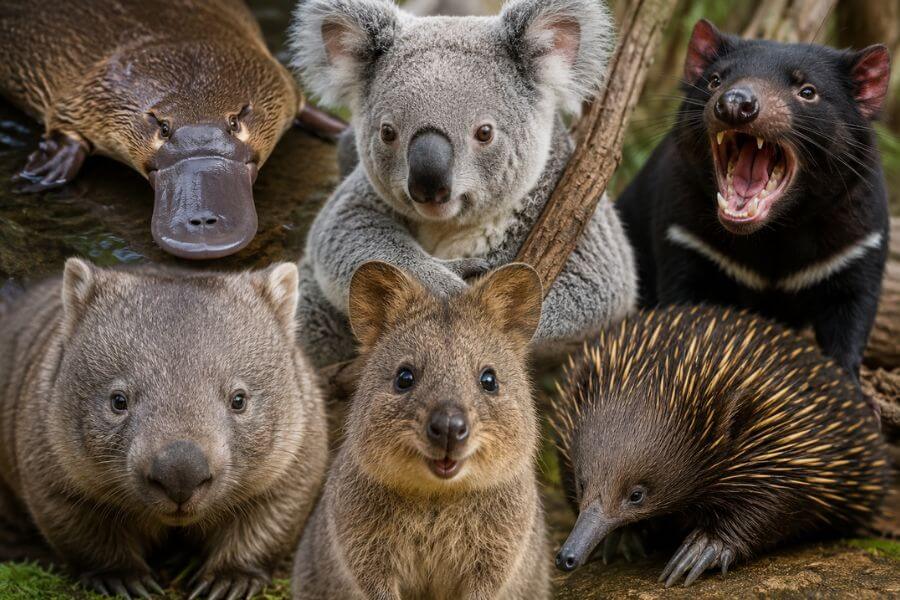
Australia is famous for having some of the most unusual wildlife on Earth. Because the continent was isolated from the rest of the world for millions of years, many animals evolved in ways you will not find anywhere else. From egg-laying mammals to tree-dwelling marsupials and colourful birds with remarkable behaviours, Australia’s wildlife feels like something from another planet.
If you love nature, visiting Australia gives you the chance to see animals that exist nowhere else in the wild. Some are iconic and easy to recognise, while others remain hidden in remote forests, deserts, and coastal regions.
In this guide, you will discover ten of the most unique animals you can only see in the Australian wild and learn what makes each one so special.
Quick Summary Table 🐨
| Rank | Animal | Where You Can See It | What Makes It Unique |
|---|---|---|---|
| 1 | Platypus | Eastern Australia | Egg-laying mammal with a duck-like bill |
| 2 | Koala | Eastern Australia | Specialist eucalyptus eater |
| 3 | Tasmanian Devil | Tasmania | World’s largest carnivorous marsupial |
| 4 | Wombat | Southern Australia | Cube-shaped droppings and powerful digging |
| 5 | Quokka | Western Australia | Famous smiling appearance |
| 6 | Numbat | Western Australia | Diurnal termite-eating marsupial |
| 7 | Bilby | Arid Australia | Long ears and desert adaptation |
| 8 | Cassowary | Tropical Queensland | Giant flightless bird with a helmet-like casque |
| 9 | Short-Beaked Echidna | Across Australia | Spiny egg-laying mammal |
| 10 | Tree Kangaroo | Rainforests of Queensland | Kangaroo adapted to life in trees |
How We Ranked These Animals 📊
We considered several factors when choosing these remarkable Australian species:
- Found only in Australia or almost exclusively in Australian ecosystems
- Unique physical features
- Unusual behaviour and adaptations
- Importance to Australia’s biodiversity
- Wildlife viewing appeal
- Scientific rarity
- Cultural significance
- Overall “wow factor” for visitors
1. Platypus 🦆
The platypus may be the strangest animal on Earth. If someone described it before it was discovered, most people would assume it was fictional. It has a duck-like bill, a beaver-like tail, webbed feet, and lays eggs despite being a mammal.
You can find platypuses in rivers and freshwater streams throughout eastern Australia. They are shy creatures and are usually most active around dawn and dusk. Spotting one in the wild requires patience, but it is an unforgettable experience.
One of the most fascinating facts about the platypus is that it belongs to a rare group of mammals called monotremes. These mammals lay eggs instead of giving birth to live young. Male platypuses even possess venomous spurs on their hind legs.
Few animals anywhere in the world can match the platypus for uniqueness.
2. Koala 🌿
The koala is one of Australia’s most recognised animals, yet it remains one of the most unusual. Unlike most mammals, koalas survive almost entirely on eucalyptus leaves, which provide very little energy and contain toxins.
To cope with this specialised diet, koalas spend much of their lives sleeping. They can rest for up to twenty hours each day to conserve energy.
You will often find koalas high in eucalyptus trees across eastern Australia. Their thick fur, large noses, and calm nature make them favourites among wildlife enthusiasts.
Although they look cuddly and relaxed, koalas are highly specialised animals whose survival depends on healthy eucalyptus forests.
3. Tasmanian Devil 😈
The Tasmanian Devil is unlike any other carnivorous marsupial alive today. Known for its powerful jaws and loud screeches, this animal has an appearance and personality that perfectly match its name.
Today, wild Tasmanian Devils are found mainly on the island state of Tasmania. They play an important role as scavengers, helping clean up carcasses and maintain ecosystem health.
Despite their fierce reputation, Tasmanian Devils are generally shy around humans. However, they can produce surprisingly loud growls, screams, and snarls when feeding.
Their stocky build and powerful bite allow them to consume nearly every part of an animal, including bones.
4. Wombat 🕳️
At first glance, wombats may look like oversized guinea pigs, but they are incredibly specialised animals. These sturdy marsupials are expert diggers capable of creating extensive underground tunnel systems.
One of the most unusual facts about wombats is that they produce cube-shaped droppings. Scientists believe this helps prevent the droppings from rolling away when used for territorial marking.
Wombats are mostly active at night and can be found in forests, grasslands, and mountainous regions of southern Australia.
Their strong claws and muscular bodies make them some of the most effective burrow builders in the animal kingdom.
5. Quokka 😊
Few animals have achieved internet fame quite like the quokka. Often called the world’s happiest animal, the quokka appears to be constantly smiling.
These small marsupials are found mainly on islands off the coast of Western Australia, particularly Rottnest Island. Their friendly appearance has made them famous worldwide.
Quokkas are naturally curious and often approach people, although feeding or touching them is not permitted.
What makes them especially unique is their limited natural range. Seeing a quokka in the wild is an experience available almost nowhere else on Earth.
6. Numbat 🐜
The numbat is one of Australia’s lesser-known wildlife treasures. This small marsupial has a striking striped coat and a long, sticky tongue perfectly adapted for catching termites.
Unlike many Australian marsupials, numbats are active during the day. A single numbat can consume thousands of termites daily.
Their sharp sense of smell allows them to locate termite colonies hidden underground. Once found, they use their claws to break into nests and feed.
Today, numbats are found mainly in parts of Western Australia, making sightings a special wildlife experience.
7. Bilby 🏜️
With its long ears, pointed nose, and silky fur, the bilby looks almost like a desert rabbit. However, it is actually a marsupial with a fascinating evolutionary history.
Bilbies are perfectly adapted to Australia’s harsh inland environments. Their large ears help regulate body temperature, while their digging skills allow them to find food and shelter.
Most bilbies are nocturnal, emerging after sunset to search for seeds, insects, and roots.
Conservation efforts have helped protect this unique species, which remains one of Australia’s most iconic desert animals.
8. Cassowary 🌴
The cassowary is one of the most extraordinary birds in the world. Standing nearly two metres tall, it resembles a creature from prehistoric times.
Found in the tropical rainforests of northern Queensland, cassowaries are flightless birds with bright blue skin, colourful necks, and a helmet-like casque on top of their heads.
These birds play a vital role in rainforest ecosystems by spreading seeds from the fruits they consume.
Although generally shy, cassowaries are powerful animals that deserve respect and distance when encountered in the wild.
Their ancient appearance makes them one of Australia’s most unforgettable wildlife species.
9. Short-Beaked Echidna 🦔
The echidna is another member of Australia’s rare monotreme family. Like the platypus, it lays eggs despite being a mammal.
Covered in protective spines, echidnas use their long snouts and sticky tongues to feed on ants and termites. They can be found across a wide range of Australian habitats, from deserts to forests.
Echidnas are excellent diggers and can disappear into the ground surprisingly quickly when threatened.
Their combination of reptile-like and mammal-like traits makes them one of the most unusual animals alive today.
10. Tree Kangaroo 🌳
When most people think of kangaroos, they picture animals hopping across open grasslands. Tree kangaroos challenge that image completely.
These remarkable marsupials have adapted to life in the rainforest canopy. They possess strong limbs, long tails, and excellent climbing abilities.
Found in the rainforests of north-eastern Queensland, tree kangaroos move through branches with impressive agility.
Their existence demonstrates how diverse Australia’s wildlife has become over millions of years of evolution.
Seeing a kangaroo in a tree is often one of the biggest surprises for visitors exploring Australia’s tropical forests.
Conclusion ⭐
Australia is home to some of the most remarkable wildlife on the planet. From the egg-laying platypus and echidna to the smiling quokka and prehistoric-looking cassowary, these animals showcase nature’s creativity in extraordinary ways.
If you are planning a trip to Australia, seeking out these species can transform an ordinary holiday into a once-in-a-lifetime wildlife adventure. Each animal offers a glimpse into the unique evolutionary history that makes Australia unlike anywhere else on Earth.
Whether you explore rainforests, deserts, rivers, or coastal islands, you will discover that Australia’s wild animals are every bit as fascinating as their reputation suggests.
Frequently Asked Questions ❓
What is the rarest animal on this list?
The numbat and tree kangaroo are among the rarest animals featured here. Their populations are limited and they occupy specialised habitats within Australia.
Which Australian animal is easiest to spot in the wild?
Koalas and wombats are often among the easier species to observe, especially in protected parks and wildlife-rich regions of eastern and southern Australia.
Are these animals dangerous to humans?
Most are not dangerous and generally avoid people. Cassowaries deserve caution due to their size and strength, while platypus males have venomous spurs, though encounters are extremely rare.
Why does Australia have so many unique animals?
Australia remained geographically isolated for millions of years. This isolation allowed species to evolve independently, creating wildlife found nowhere else on Earth.
What is the best time of year to see Australian wildlife?
Spring and autumn are often excellent seasons because temperatures are comfortable and many animals are active. However, wildlife can be observed year-round depending on the region and species.