Across the world, ancient buildings are getting a second chance at life. Old fortresses, quiet monasteries, and grand royal homes are turning into places where travelers can spend the night. Staying in these buildings lets you touch history instead of just reading about it in a book. You get all the comfort of a modern room while living inside a real piece of the past. Let us explore how these amazing places changed from old ruins into dream destinations.
Key Takeaways
Before we dive deep into the world of historic travel, here are the most important things to keep in mind:
- Living History: Converted hotels let you experience the past with your five senses, offering something far more exciting than a standard room.
- Preservation: Staying in these hotels helps save ancient buildings from being torn down, which protects local culture.
- Unique Spaces: No two rooms are exactly the same because the hotels must fit inside the original shapes of the old buildings.
- Global Adventure: You can find these incredible places all over the world, from the green hills of Europe to the ancient cities of Asia.
The Magic of Turning the Past into the Present
When you travel, you usually have to choose between a modern hotel with great features or an old museum with lots of stories. Converted historical hotels give you both at the same time. These are buildings that were originally made for a totally different reason. They were built to keep enemies out, to give people a quiet place to pray, or to show off the wealth of a royal family.
Over time, the world changed. Wars ended, old ways of life faded, and many of these giant structures became empty. Instead of letting them crumble into dust, creative architects and historians teamed up. They found ways to put in modern plumbing, fast internet, and cozy beds without ruining the old walls.
The result is a special kind of travel magic. You might find a swimming pool built inside an old wine cellar. You might eat dinner in a room where knights once planned great battles. The people who run these hotels work hard to keep the original spirit of the building alive. They leave the old marks on the walls, the original wooden beams in the ceiling, and the ancient symbols carved into the stone. It creates an atmosphere that makes you feel like a time traveler.
Why Staying in a Historic Hotel Changes Your Vacation
Most modern hotels look exactly the same no matter what city you are in. They have the same white walls, the same square beds, and the same boring lobbies. Historic hotels are the exact opposite. Every single one has its own personality, its own smell, and its own voice.
When you choose a historic hotel, your accommodation becomes the main event of your trip. You do not just use your room as a place to drop your bags and sleep. You want to explore the hallways, read the stories on the lobby walls, and sit in the courtyard. It changes the way you think about travel. You start to care less about rushing to see every tourist spot in town because the best tourist spot is the place where you are sleeping.
From Holy to Hospitality: The Transformation of Monasteries and Convents
For hundreds of years, monasteries and convents were places of deep silence, hard work, and intense focus. Monks and nuns lived far away from the busy world. They built beautiful, sturdy structures with thick walls, peaceful inner gardens, and long hallways. Today, many of these holy spaces are opening their heavy wooden doors to everyday travelers.
The Anatomy of a Holy Space
To understand why old convents make such amazing hotels, you have to look at how they were built. They were designed to help people find inner peace. That means they are usually located in very quiet areas, like high on a hill or deep in a valley.
The central part of almost every convent is the cloister. This is a square, open-air courtyard surrounded by a covered walkway with stone arches. In the past, holy people would walk around this square while reading or thinking deeply. Today, these courtyards often serve as the heart of the hotel. They are filled with lush green plants, beautiful fountains, and comfortable chairs where you can read a book or sip a cool drink.
The rooms where guests sleep used to be called cells. Do not let that word scare you. While they used to be very simple with just a hard bed and a small desk, hoteliers have opened them up. Sometimes two or three old cells are combined to make one big, luxurious bedroom. The windows are often small but perfectly shaped to let in a beautiful beam of sunlight, keeping the room cool in the summer and warm in the winter.
What to Expect When You Stay in an Old Convent
Staying in a converted religious building is a unique experience. The first thing you will notice is the silence. Even if the hotel is in the middle of a busy city like Rome or Paris, the thick stone walls block out all the street noise. It feels like stepping into a different world.
The design usually stays simple and elegant. You will not find bright, flashy colors or strange modern art. Instead, you will see a lot of natural wood, soft white fabrics, and exposed stone. Many of these hotels also keep old pieces of art, like ancient paintings of saints or beautiful stone crosses, as a sign of respect for the past.
| Feature of Old Convent | How It Is Used Today | Why Guests Love It |
| Inner Courtyard | Outdoor Dining Area or Garden | Peaceful spot to relax away from city noise |
| Old Monk Cells | Luxury Guest Bedrooms | Unique room layouts with deep historic feel |
| High-Ceiling Dining Hall | Hotel Restaurant | Beautiful atmosphere for eating breakfast |
| Ancient Library | Guest Lounge or Reading Room | Filled with old-world charm and quiet spaces |
Sleeping Like Royalty: The World of Castle Hotels
If convents are all about quiet peace, castle hotels are all about drama, power, and luxury. Castles were built to do two things: defend a territory from attackers and show everyone who was boss. They have towering walls, heavy iron gates, secret passageways, and massive fireplaces. Turning these giant stone fortresses into cozy hotels is a huge challenge, but the results are breathtaking.
The Thrill of the Fortress
Approaching a castle hotel for the first time is something you never forget. You often have to drive up a long, winding road or cross over an old moat. The massive stone towers look down on you, making you feel small but incredibly excited.
Inside, everything is grand. The ceilings are so high that you have to crane your neck to see the top. The walls are covered in massive tapestries, which are large woven wall hangings that used to keep the cold stone walls warm. You might see suits of armor standing guard in the corners of the hallways, or massive crystal chandeliers hanging from the ceiling.
The Different Types of Castle Accommodations
Not all castles are the same. Depending on where you travel, you will experience a totally different style of royal living.
Medieval Fortresses
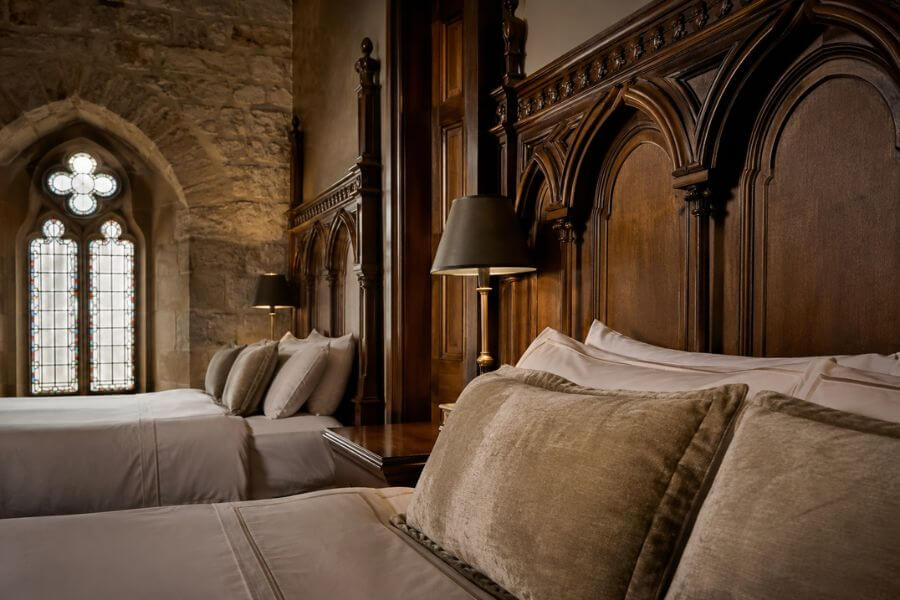
These are the oldest castle hotels, often found in countries like England, Scotland, and Germany. They were built during a time of constant war, so they focus heavily on defense. You will see super thick walls, narrow windows used by archers, and stone battlements where guards used to watch for enemies. The rooms here feel rugged and strong, often featuring large four-poster beds made of dark wood and heavy stone walls that make you feel totally safe from the outside world.
Renaissance Palaces
Found commonly in Italy and France, these buildings were made after the Middle Ages when lords cared more about art, beauty, and comfort than defense. These hotels feature large windows that let in tons of light, beautiful ceiling frescoes, which are paintings done directly into wet wall plaster, and sprawling gardens with perfectly cut hedges and marble statues. Staying here makes you feel like an art collector or a sophisticated prince.
Key Features of a Castle Stay
When you book a room in a castle, you are signing up for an adventure. Many of these properties offer activities that match their history. You might be able to try archery on the lawn, watch a falconry show where trained birds fly right to your gloved hand, or take a tour of the secret tunnels beneath the building.
The dining experience in a castle is also top-notch. Meals are often served in the great hall, where massive log fires burn in the fireplace. The tables are long, the chairs have high backs, and the food is often inspired by traditional local recipes, giving you a literal taste of the past.
Guarding the Coast: Historic Forts and Military Outposts
While castles were built for lords and ladies, forts were built for soldiers. These buildings are often rougher, tougher, and located in some of the most extreme places on earth. Many sit right on the edge of rocky cliffs overlooking the ocean, while others sit on tiny islands in the middle of the sea. Turning these military heavyweights into luxury hotels takes a lot of creativity.
Rugged Outside, Luxury Inside
The contrast is what makes fort hotels so cool. From the outside, they look like unbreakable blocks of gray stone or dark brick. They have tiny windows, heavy iron doors, and platforms where giant cannons used to sit. But once you cross the threshold, you step into pure luxury.
Architects love working with forts because the spaces are so unusual. Old gunpowder storage rooms get turned into trendy bars. Underground bomb shelters become beautiful spa areas with heated pools. The flat roofs where soldiers used to march become massive sun decks with panoramic views of the water.
The Incredible Views
Because forts were designed to spot enemy ships or armies from far away, they have the best views of any hotels in the world. When you stay in a coastal fort, your window will look straight out at the crashing waves. You can fall asleep to the sound of the ocean hitting the stone walls below your bed. In the morning, you can walk along the old stone ramparts, which are the wide protective paths on top of the fort walls, and watch the sunrise over the water.
Trading Posts and Inns of the Old Silk Road: Caravanserais
In Asian and Middle Eastern countries, history took a different path. Instead of convents and western castles, the most important historic buildings were caravanserais. These were roadside inns where traders traveling along the famous Silk Road could rest with their animals after a long day of walking across deserts and mountains.
The Layout of a Desert Oasis
A caravanserai was built like a safe box in the desert. It usually had one massive, fortified gate that could be locked tight at night to protect traders from bandits. Inside, it opened up into a beautiful, two-story courtyard.
The ground floor was used for the camels, horses, and donkeys, as well as for storing valuable trade goods like silk, spices, and carpets. The upper floor featured dozens of small rooms where the travelers slept.
Modern Comfort in an Ancient Oasis
Today, these beautiful brick and mud-stone structures are being restored into stunning boutique hotels, especially in countries like Uzbekistan, Iran, and Turkey. The central courtyards are now filled with colorful carpets, soft cushions, and low tables where guests can drink hot tea and eat fresh fruit.
The guest rooms feature beautiful geometric brickwork, colorful tiled floors, and arched ceilings. Staying in a caravanserai gives you a deep connection to the history of global trade. You are sleeping in the exact same spot where travelers from thousands of years ago shared stories from distant lands.
Comparing the Historical Hotel Styles
To help you decide which kind of historic hotel matches your travel style, let us compare the main options side-by-side.
| Hotel Type | Original Purpose | Best For | Atmosphere | Common Location |
| Convent / Monastery | Religious life and quiet prayer | Relaxation, quiet reflection, writing | Peaceful, simple, calm | Italy, Spain, France |
| Castle | Royal living and regional defense | Romance, families, adventure | Grand, luxurious, dramatic | Scotland, Germany, England |
| Fort | Military protection and coastal defense | Ocean views, unique design lovers | Strong, rugged, isolated | Coastal areas, islands |
| Caravanserai | Roadside rest for desert traders | Culture lovers, exotic adventures | Cozy, colorful, social | Turkey, Central Asia |
The Challenge and Art of Historical Preservation
It is easy to look at a beautiful historic hotel and forget how much work went into creating it. Transforming an ancient building is a massive puzzle that takes years to solve. Governments have strict rules to protect historic structures, meaning developers cannot just change whatever they want.
Working Around the Rules
In many countries, you are not allowed to drill holes into ancient stone walls or remove old wooden beams. This means hotel designers have to get incredibly creative.
If they cannot put pipes through a wall to make a bathroom, they might build a special glass box inside the room that holds the shower and toilet without touching the historic stone. If they cannot install modern air conditioning units on the roof because it ruins the look of the building, they have to hide the cooling vents inside old chimneys or under the floorboards.
Balancing Old and New
The best converted hotels find a perfect balance. They do not try to hide the age of the building, but they also do not make you live like a medieval peasant. You get a historic room, but you also get a bed that is soft, water that is hot, and a television that is hidden behind an old painting. This careful balance keeps the history alive while making sure guests actually enjoy their stay.
Step-by-Step: How a Historic Building Becomes a Hotel
The journey from a abandoned ruin to a five-star hotel is long and complicated. Let us look at how this transformation happens step-by-step.
1.Discovery and Assessment:Finding the perfect building.
An expert team finds an empty historic building. Historians and engineers check the walls to make sure the structure is safe and see what parts can be saved.
2.Planning and Permission:Getting approval from experts.
Architects draw up plans that add luxury features while protecting the old style. They must present these plans to government history boards to get special permission.
3.Stabilization and Cleaning:Fixing the ancient bones.
Workers carefully clean centuries of dirt, dust, and mold off the stone and wood. They strengthen the foundation and fix any leaks in the ancient roof.
4.Modern Infrastructure:Hiding the wires and pipes.
Plumbers and electricians run miles of hidden cables and pipes through the building to provide hot water, electricity, and high-speed internet without ruining the look.
5.Interior Design and Furnishing:Decorating with respect.
Designers choose furniture that matches the history of the building. They bring in local antiques, custom-made beds, and lighting that highlights the historic architecture.
Ghost Stories and Legends: The Fun Side of Historic Hotels
You cannot talk about historic hotels without mentioning their most famous, and sometimes invisible, guests. When a building has existed for hundreds of years, it collects a lot of stories. Many castle and convent hotels are famous for their legends and ghost stories.
Friendly Spirits
Most historic hotels love their resident ghosts. They are rarely scary. Instead, they are usually described as playful spirits, like a long-dead maid who likes to tidy up rooms when guests are out, or a medieval knight whose footsteps can be heard walking down the hallway at exactly midnight.
Whether you believe in ghosts or not, these stories add a fun layer of mystery to your stay. Reading about the legends of your hotel in the evening makes exploring the dark hallways at night feel like being in a movie.
Fact or Fiction?
Many times, these legends are based on real historical events. A hotel might have a room called the King James Room because the king actually stayed there in the year 1603. Learning about the real people who slept in your room centuries ago makes you feel connected to the grand story of human history.
Tips for Planning Your First Historic Hotel Stay
If you are ready to book your first stay in a castle, convent, or fort, there are a few tips you should know to make sure you have the best possible time.
Research the History Before You Arrive
The more you know about the building, the more fun your stay will be. Spend an hour reading about the history of the hotel on its website before you pack your bags. Knowing who built it, why they built it, and what happened there will make you appreciate every little detail when you finally walk through the door.
Pack Wisely for Old Buildings
Historic buildings often have a few quirks that you need to prepare for. Here are a few things to keep in mind:
- Bring Good Shoes: Old stone floors can be uneven, and castles often have steep, winding stairs. Leave your high heels at home and pack comfortable walking shoes.
- Pack a Light Bag: Many historic hotels do not have elevators because they cannot install them without ruining the structure. You might have to carry your bag up a couple flights of stairs, so do not overpack.
- Bring a Sweater: Thick stone walls are great at keeping heat out, which means these buildings can sometimes feel a bit chilly or drafty, even in the summer. A cozy sweater is always a good idea.
Talk to the Staff
The people who work at historic hotels are usually very passionate about the building. Do not be afraid to ask the front desk clerks or the waiters about the history of the property. They often know the best stories, the secret spots that most tourists miss, and the coolest facts about how the building was saved.
Frequently Asked Questions
Are historic hotels safe to stay in?
Yes, they are completely safe. Even though the buildings are very old, they must pass the exact same modern safety inspections as a brand-new hotel. The foundations are strengthened with modern engineering, and smoke detectors, fire alarms, and emergency lights are carefully hidden throughout the property to keep you safe without changing the vintage look.
Do these hotels have modern bathrooms and internet?
Absolutely. You do not have to worry about using ancient facilities. While the bedrooms keep their historic charm, the plumbing and technology are totally modern. You will find beautiful luxury showers, hot running water, modern toilets, and fast wireless internet in almost every converted hotel today.
Can kids and families stay in converted historic hotels?
Yes, families are very welcome. In fact, kids usually love staying in these properties because they feel like they are living inside a storybook or a video game. Exploring a real castle, seeing old armor, and walking along fort walls are unforgettable experiences for young travelers. Some hotels even offer special historical treasure hunts for children.
Why are historic hotels sometimes more expensive than regular hotels?
It costs a lot more money to repair and maintain an ancient building than it does to build a new one. Fixing old stone, restoring centuries-old paintings, and running hidden wires through thick walls requires highly skilled workers and expensive materials. When you pay to stay at a historic hotel, part of your money goes directly toward preserving the building so future generations can enjoy it too.
Are all the rooms in a historic hotel exactly the same?
No, and that is one of the best parts about them. In a standard hotel, every room is a perfect copy of the next. In a historic hotel, every room is shaped by the original architecture of the building. One room might have a giant stone fireplace, another might have a cozy arched ceiling, and a third might feature a beautiful view from an old tower window. Every stay is completely unique.