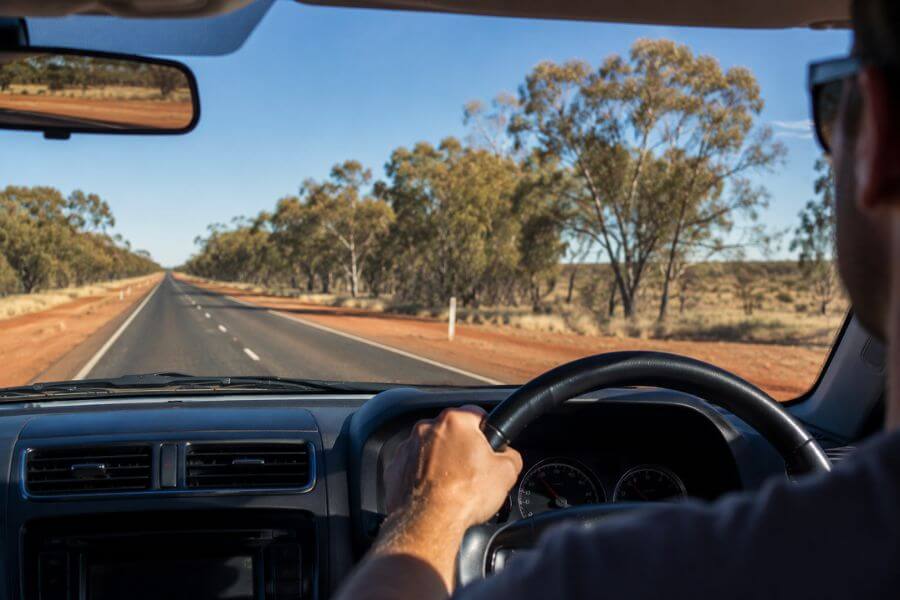
Imagine this: you are sitting in the driver’s seat, ready to start a grand road trip. But when you look down to change gears, your hand hits the car door instead of the gear stick. You look up, and every single oncoming vehicle is heading toward you on what feels like the wrong side of the road.
Welcome to land down under! Driving across this beautiful country is one of the best ways to see its stunning sights, from golden beaches to the deep red dirt of the middle desert. However, swapping your American keys for an Australian rental car requires you to change how you think about the road. This guide will help you understand how to navigate the highways and tracks safely so you can focus on the adventure.
Key Takeaways
Before you start your engine, here are the most important things to remember for your journey:
- Left-Hand Driving: You must always drive on the left side of the road. The driver’s seat is on the right side of the vehicle, which takes some time to get used to.
- Licence Requirements: Your valid US driver’s licence is legal to use in most parts of the country as a visitor, but you must carry it with you at all times.
- Outback Hazards: The remote areas of the country can be dangerous. You need extra water, fuel, and communication tools because phone signals disappear quickly.
- Wildlife Warnings: Large animals like kangaroos are highly active during sunrise and sunset. Avoid driving at these times to stay safe.
- Strict Traffic Laws: Speed limits and alcohol laws are watched very closely by police. Even a tiny bit over the limit can lead to huge fines.
Legality and Paperwork: Can You Drive on a US Licence?
The short answer is yes! If you hold a current, valid driver’s licence from any US state, you can legally drive in Australia as a temporary tourist. The country recognises US licences because they are printed in English and come from a country with high testing standards. However, each Australian state and territory sets its own traffic laws, so rules can vary slightly depending on where your plane lands.
Staying Within Your Category
You can only drive the same types of vehicles that your American licence allows. If you have a standard car licence in Texas or California, you can drive a standard passenger car or a small rental SUV in Sydney or Brisbane. You cannot jump into a massive heavy truck or a large commercial vehicle unless you hold a special commercial licence back home.
The Paperwork to Carry
Whenever you are behind the wheel, you must have your physical US licence with you. Digital licences on your phone are becoming more common, but it is always safest to carry the plastic card. If a police officer pulls you over for a routine check, they will need to see it immediately.
If you plan to stay for more than three months, or if you are moving between different states on a working holiday, check the local transport website for that specific state. Some areas require you to get a local licence after a certain number of months.
Do You Need an International Driving Permit?
Because US licences are in English, an International Driving Permit is generally not mandatory for short holiday trips. However, it is a great extra document to have. It acts as an official translation and verification of your licence, which can make things move much faster at the rental car desk or during a roadside police chat.
Shifting Your Perspective: Getting Used to the Right Side
The biggest hurdle for any American driver is moving from the right side of the asphalt to the left. It sounds simple in theory, but your brain has spent years building habits that you now have to break.
The Layout of the Car
When you open the door of an Australian car, you will climb into what Americans consider the front passenger seat to drive. Everything inside is flipped. The rearview mirror is to your left. The centre console, where you adjust the radio or climate control, is also to your left.
Thankfully, the foot pedals stay in the exact same order. The accelerator is on the right, the brake is in the middle, and the clutch (if you are driving a manual vehicle) is on the left. You will still use your right foot for gas and braking, which provides a comforting bit of familiarity.
The Windscreen Wiper Trap
This is a funny mistake that every single tourist makes at least ten times during their first week. In many Australian vehicles, the levers on the steering wheel column are reversed. The indicator lever for your turn signals is on the right, and the windscreen wiper control is on the left.
When you approach your very first intersection and try to signal a right turn, you will almost certainly turn your wipers on full blast instead. Do not panic when this happens. Just laugh, turn them off, and use the other lever.
Staying Centred in the Lane
When you drive in the US, your body is positioned on the left side of the vehicle, close to the centre dividing line of the road. In Australia, because you are sitting on the right side of the car, you must position yourself close to the centre line on your right.
This flip often causes Americans to drift too far toward the left edge of the road, scraping tyres against curbs or hitting loose gravel on the shoulder. To fix this, try to look far down the road and align the right side of your body with the right-hand lane marking.
Navigating Australian Roads: Crucial Rules of the Left
Once you are moving, you need to know how traffic flows. While many signs look similar to the ones back home, the way drivers interact at intersections can be quite different.
The Golden Rule of Roundabouts
Australia loves roundabouts. You will find these circular intersections everywhere, from quiet country towns to busy city centres. They replace traditional four-way stops and keep traffic moving smoothly, but they can be terrifying if you are not used to them.
The most important rule to memorise is this: always give way to traffic already in the roundabout coming from your right. You must wait for a clear gap before you enter the circle. Once you are inside, you move in a clockwise direction.
Signaling in a roundabout can also feel tricky. If you want to turn left, look left and signal left as you enter. If you want to go straight, do not signal as you enter, but flick your left signal on just as you pass the exit before the one you want. If you are turning right, signal right as you enter, and then switch to a left signal as you approach your exit to let other drivers know you are leaving the circle.
Giving Way and Turning
Unlike in the US, where turning right on a red light is legal in many places after a complete stop, there is no equivalent rule in Australia. A red light means stop and stay stopped. You cannot turn left on a red light unless there is a specific sign that says “Left Turn on Red Permitted after Stopping.”
At unmarked intersections or intersections where two roads meet without signs, the general rule is to give way to vehicles approaching from your right. Always look both ways, but pay extra attention to your right side.
Understanding Road Markings and Overtaking
Passing another vehicle is called overtaking in Australia. The lines painted on the road tell you when it is safe to do so.
A broken single white line means you can cross it to overtake if the road ahead is clear. A solid single white line or a double solid white line means you must stay in your lane and cannot cross to pass. Sometimes you will see a double line where one side is solid and the other is broken. In this case, you can only pass if the broken line is on your side of the road.
Speed Limits, Enforcement, and Zero Tolerance
Australia takes road safety incredibly seriously. The approach to policing the highways is strict, and there is very little room for error.
The Metric Transition
The first thing to note is that Australia uses the metric system. All speed limit signs are in kilometres per hour instead of miles per hour. Your rental car speedo will also be in kilometres per hour, so you just need to match the number on the dashboard to the number on the roadside signs.
Common speed limits include:
- 50 kilometres per hour: Standard limit for built-up city and suburban areas.
- 40 kilometres per hour: School zones during drop-off and pick-up times, or busy shopping strips.
- 100 or 110 kilometres per hour: Major highways and country roads.
Hidden Cameras and Big Fines
In the US, you are often used to seeing a police car parked on the median strip waiting to catch speeders. In Australia, while highway patrol cars are common, a massive amount of enforcement is done by automated technology.
Fixed speed cameras are mounted on poles, and mobile speed cameras are placed in unmarked cars parked on the side of the road. There are also point-to-point cameras that calculate your average speed between two distant spots on a highway. If you are even a few kilometres over the limit, a camera will catch you, and a hefty fine will be mailed directly to your rental company. There is no unwritten buffer like the “five miles per hour over” habit in America.
Alcohol and Phone Laws
Drink driving laws are harsh. For most fully licensed drivers, the blood alcohol limit is 0.05 percent. This is much lower than the 0.08 percent limit found in most US states. A single standard drink can put you close to the limit, so the safest option is to have zero alcohol if you plan to drive. Police set up random breath testing zones on any road at any time. You will be asked to blow into a machine, and if you are over the limit, you can lose your licence on the spot.
Using a mobile phone while driving is completely illegal. You cannot hold your phone, look at your lap, or touch the screen while stopped at a red light. Cameras can see through your windscreen to spot phones in laps, resulting in massive fines and loss of driving privileges. If you need to use your phone for maps, it must be securely mounted to the vehicle in a commercial cradle, and you should set your destination before you start moving.
Urban Driving vs. Country Driving: Two Different Worlds
Driving through the concrete streets of Melbourne is a world away from cruising down a quiet coastal highway in Western Australia. You need to adjust your style depending on your surroundings.
Surviving the City
Australian cities are old, and many roads were designed before cars existed. This means lanes can be narrow, and parking can be hard to find.
If you are driving in Melbourne, you will encounter historic trams that share the middle of the street with cars. You must learn the hook turn, a unique rule where you turn right from the far-left lane to avoid blocking the tram tracks. You pull forward into the intersection on the left, wait for the light on the road you want to enter to turn green, and then complete your turn.
In every major city, watch out for bus lanes and transit lanes. These are reserved for public transport and cars with multiple passengers during rush hours. Look closely at the signs to avoid a fine.
Heading into the Country
As you leave the high-rise buildings behind, the roads change. Highway surfaces can become rougher, and you will often find two-lane roads with narrow shoulders.
Country driving requires high concentration. Distances between towns are large, and you can easily become tired. The phrase “Stop. Revive. Survive.” is printed on big blue signs along highways to remind you to pull into a rest stop every two hours for a stretch and a break.
Driving Conditions Comparison
To help you visualise how these environments differ, take a look at how city roads compare to the regional routes you will encounter on your journey:
| Feature | City Driving | Country and Regional Highways |
| Lane Width | Narrow with tight corners | Wide but often lacks a paved shoulder |
| Traffic Flow | Stop-and-start with heavy congestion | High speed with long stretches of open road |
| Common Hazards | Trams, pedestrians, and sudden lane changes | Potholes, loose gravel, and wandering animals |
| Navigation | Complex intersections and many signs | Straight paths with few turn-offs |
| Fuel Availability | Fuel stations on almost every corner | Stations can be separated by long distances |
Welcome to the Outback: The Ultimate Road Test
The true Australian outback is a beautiful, silent, and ancient landscape. It offers an incredible sense of freedom, but it is also an environment that does not forgive mistakes. If you plan to drive into the remote interior of the country, you must treat the land with respect.
Defining the Remote Zones
The outback is not just the countryside; it is a term used for the vast, dry, and unpopulated areas that cover the majority of the continent. Here, the towns have populations of fewer than a hundred people, and you might drive for an entire afternoon without seeing another human being.
Vehicle Selection: Do You Need a Four-Wheel-Drive?
If you are sticking to the main highway that runs straight through the centre of the country from Adelaide up to Darwin, a standard two-wheel-drive car or campervan is perfectly fine because the road is fully sealed with asphalt.
However, if you want to explore national parks, visit remote gorges, or travel down famous dirt paths like the Oodnadatta Track, you absolutely must have a high-clearance four-wheel-drive vehicle. A standard car will get stuck in deep sand, damage its underside on sharp rocks, or break its suspension on corrugated dirt surfaces. Check your rental contract carefully, as many companies completely ban standard cars from leaving paved roads.
The Art of Dirt Road Driving
Driving on unsealed surfaces is a specific skill. Dirt roads can look solid, but they are often covered in loose gravel that acts like tiny marbles under your tyres. If you take a corner too fast, your vehicle can easily slide out of control.
Watch out for corrugations, which are a series of ripples in the dirt caused by traffic. They cause the entire car to shake violently. The best way to handle them is to slow down to a steady speed that allows the tyres to float over the ridges rather than slamming into each one.
Be careful of bulldust too. This is an extremely fine, powdery red dust that fills deep potholes. It looks like flat ground from a distance, but when your front tyre hits it, the car can yank hard to one side, and a giant cloud of dust will instantly block your view through the windscreen.
The Survival Checklist: Preparing Your Vehicle and Self
When you head into remote areas, you become your own rescue team. You cannot rely on a quick phone call to emergency services if something goes wrong. You must pack the right gear before you leave the last major regional town.
Water and Food Rules
The outback is hot and dry, with summer temperatures regularly climbing past forty degrees Celsius. Dehydration can happen fast.
You should carry at least five to seven litres of fresh drinking water per person, per day. Keep this water in multiple smaller containers rather than one big jug. That way, if one container springs a leak on a bumpy road, you do not lose your entire life-saving supply. Pack enough non-perishable food to last you at least three to four days longer than your planned trip.
Fuel Management
In the US, you are used to fuel stations appearing every few miles. In the outback, roadhouses can be two hundred to three hundred kilometres apart.
Make it a strict rule to top up your fuel tank at every single roadhouse you pass, even if your fuel gauge says you are still half full. You never know if the next station will be closed, out of fuel, or suffering a power outage. If you are taking very remote tracks, carry an extra metal jerry can of fuel secured safely on the outside or rear of your vehicle.
Communication Tools
Do not rely on your US mobile phone roaming plan or even a local Australian tourist SIM card. Once you drive a few hours inland from the coast, standard mobile phone towers disappear completely.
For real safety, consider renting a satellite phone or a Personal Locator Beacon. A beacon is a small handheld device with an antenna. If you have a life-threatening emergency, you flip the switch, and it sends your exact location to a search-and-rescue satellite network.
Encounters with Giants: Road Trains and Wildlife
Two unique elements of Australian driving require special attention: the largest trucks you will ever see, and animals that like to use the road as a playground.
Understanding Road Trains
A road train is a massive truck that pulls three, four, or sometimes five large trailers behind it. These vehicles can be up to fifty-three metres long and weigh more than a hundred tonnes. They move at high speeds and cannot stop quickly or swerve without risking a major crash.
When a road train is coming toward you on a narrow or unsealed country road, the safest move is to slow down, pull as far to the left as possible, or even pull completely off the road onto the dirt shoulder and stop. This keeps you safe from the giant stones and dust clouds kicked up by the truck, which can easily crack your windscreen or blind your vision.
Overtaking a road train requires an immense amount of clear road. Because they are so long, it can take a standard car up to a full minute of high-speed driving to pass one completely. Never attempt to pass a road train unless you can see a completely clear horizon with no oncoming traffic for kilometres ahead.
Wildlife Hazards
The Australian emblem is the kangaroo, and while they are beautiful to look at, they are a major hazard for drivers. Kangaroos are strong, heavy, and completely unpredictable. They are often attracted to the sides of roads because rainwater runs off the pavement, creating patches of green grass.
Kangaroos, emus, and stray cattle are most active during dawn, dusk, and nighttime. They can easily jump directly in front of your moving car with zero warning. If an animal leaps into your path, the golden rule is to brake hard in a straight line, but do not swerve violently to miss it. Swerving at high speeds on country roads often causes cars to roll over into the ditch or crash into large trees, which is far more dangerous than hitting the animal.
To avoid this entirely, simply plan your trip so you arrive at your destination before the sun starts to set. Put the keys away, grab a cold drink, and watch the sunset from the safety of a town or campsite.
What to Do in an Emergency: The Ultimate Golden Rule
If your vehicle breaks down, you get a flat tyre, or you run out of fuel in a remote area, there is one rule that saves lives above all others: always stay with your vehicle.
The Danger of Walking
It can be incredibly tempting to look at your map, see a town that looks only ten kilometres away, and decide to walk there for help. Do not do it. The outback heat is intense, and the horizon is confusing. People who leave their cars quickly become lost, exhausted, and severely dehydrated.
Why Your Car is Your Best Friend
Your car provides shelter from the burning sun. It holds your large supply of water and food. Most importantly, a car is a massive metal object that is incredibly easy for police search planes or passing truck drivers to spot from a distance. A single human walking through the scrub is almost invisible from the air.
If you stay with your vehicle, conserve your water, and wait calmly, help will find you. Use your mirrors or a reflective blanket to catch the sun and signal any passing planes or distant vehicles.
Frequently Asked Questions
Can I drive an automatic car in Australia if my US licence is for an automatic only?
Yes. Most rental cars in Australia are automatic, though manual vehicles are sometimes cheaper or more common for rugged four-wheel drives. Your US licence allows you to drive either, but make sure you book an automatic online in advance if you are not comfortable shifting gears with your left hand.
What should I do if I accidentally drive onto the right side of the road?
If you realise you have drifted onto the right side, do not panic. Check your mirrors, slow down, and safely indicate to pull over to the left shoulder as soon as possible. Take a deep breath, reorient yourself, and remember that the driver’s seat should always be closest to the middle of the road.
Are there toll roads in Australia, and how do I pay them with a US credit card?
Yes, major cities like Sydney, Brisbane, and Melbourne have many toll roads. There are no physical toll booths where you can stop and pay cash. Instead, cameras photograph your number plate. Most rental car companies have an automated system where they link the car plate to your credit card for a small daily fee. Always ask your rental agent about their toll policy before leaving the lot.
How do I find fuel and water locations before heading into the deep outback?
You should download offline mapping apps onto your phone before you lose internet access. Excellent local options include digital maps that list every outback roadhouse, campsite, and water point, complete with reviews from recent travellers showing if the station has fuel available.
What are cattle grids, and how should I drive over them?
A cattle grid is a series of metal bars laid across a gap in a fence on the road surface. It stops cows and sheep from crossing boundaries because their hooves slide through the bars. When you see one, slow down slightly and drive straight over it. Your tyres will make a loud rumbling noise as you cross, which is completely normal. Keep your steering wheel straight and avoid braking while directly on top of the slippery metal bars.