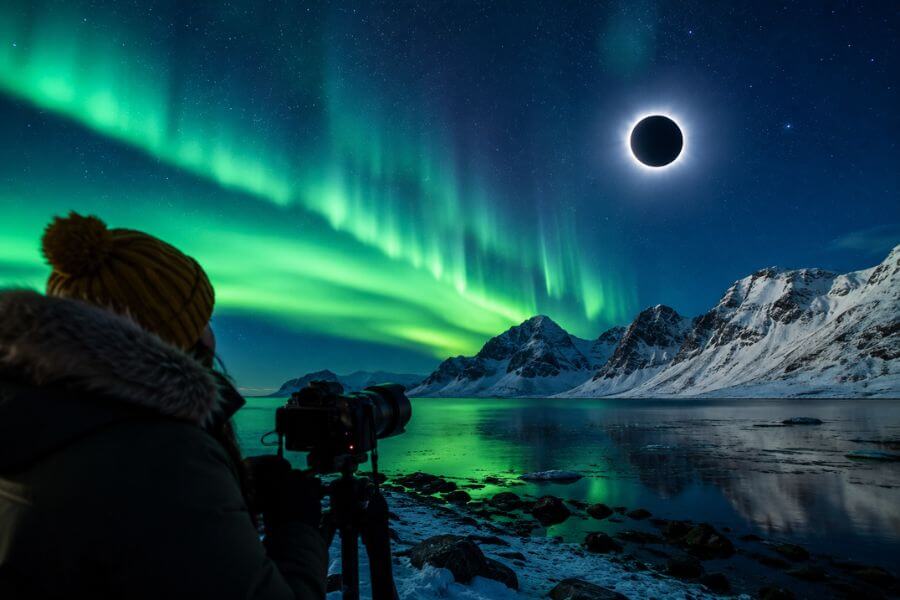
Look up at the sky. A whole new world is waiting for you above the clouds. Traveling to see the stars, the sun, and the moon is becoming one of the most exciting ways to spend a vacation. You do not have to be a rocket scientist to enjoy the show. You just need a sense of wonder and a solid plan. Whether you want to see the sun disappear behind the moon or watch neon green lights dance in the dark, this complete guide will help you prepare. Get ready to pack your bags, gather your friends, and chase the magic of the universe.
Key Takeaways
- Plan far ahead: Sky events require you to pick the right dates and locations long before you leave your house.
- Protect your body: You must wear the correct layers for freezing weather and use special certified glasses to protect your eyes from the sun.
- Bring the proper gear: A good camera, a steady tripod, and plenty of hot snacks will make your adventure much more enjoyable.
- Respect the wild: Always leave your viewing spot cleaner than you found it and be polite to the local towns you visit.
- Stay highly flexible: Weather can change very quickly, so having a backup route is always a smart idea.
- Enjoy the moment: Remember to put your camera down for a few minutes to watch the sky with your own two eyes.
The Magic of Celestial Tourism
A New Way to Travel
Most people plan their vacations around beaches, theme parks, or big cities. Celestial tourism is entirely different. When you become a sky tourist, you plan your travels around what is happening in space. You might drive for hundreds of miles just to stand in a specific shadow. You might fly to the coldest parts of the world just to look up at the night sky. This type of travel connects you to the universe in a very special way. It reminds you how big the world is and how many beautiful things happen naturally every single day.
The Thrill of the Chase
There is a feeling of great excitement that comes with chasing a natural event. Unlike a movie that starts at the exact same time every day, the sky is wild and natural. You have to hunt for clear skies. You have to wait patiently in the cold or the heat. When the clouds finally part and you see the glowing colors of the aurora or the dark circle of an eclipse, the reward is massive. You feel a rush of pure joy because you worked hard to get to that exact spot at that exact second.
Why People Love the Night Sky
Humans have always been fascinated by the sky. Thousands of years ago, people used the stars to find their way across oceans. They used the sun to know when to plant their crops. Today, looking at the sky gives us a break from our busy lives. When you look at the stars, you stop worrying about homework, chores, or loud traffic. You get to feel calm and peaceful. Sky-watching is a quiet hobby that brings friends and families closer together.
All About Solar Eclipses
What Happens During an Eclipse
A solar eclipse happens when the moon moves exactly between the earth and the sun. Even though the sun is much bigger than the moon, it is also much farther away. From our point of view on the ground, the sun and the moon look like they are the exact same size. When they line up perfectly, the moon blocks the light from the sun. The sky gets dark in the middle of the day. The air suddenly feels cold. The birds stop singing because they think it is time to sleep.
The Path of Totality Explained
To see a total solar eclipse, you have to be standing in the perfect spot. This spot is called the path of totality. This path is a narrow strip across the map where the shadow of the moon completely covers the sun. If you stand outside of this narrow path, you will only see a partial eclipse. A partial eclipse is still interesting, but it is not the full show. Standing inside the path of totality is the only way to see the day turn into night.
The Diamond Ring Effect
Right before the sun is completely covered, something beautiful happens. A single bright spot of sunlight shines through a valley on the edge of the moon. At the same time, a faint ring of light glows around the rest of the moon. This makes the sun look exactly like a giant diamond ring hanging in the sky. This spectacular sight only lasts for a few seconds. When the diamond ring fades, totality begins.
Animal Behavior During the Dark
One of the most interesting things about a solar eclipse is how the animals react. Cows might walk back to their barns. Chickens might go to roost. Crickets will start chirping as if the sun has set. Dogs and cats might act confused or sleepy. Watching the animals around you is a very fun part of the eclipse experience. You get to see how deeply all living things are connected to the light of the sun.
Types of Solar Eclipses Summary
| Type of Eclipse | What You See in the Sky | How Often It Happens | Do You Need Safety Glasses? |
| Total Eclipse | The sun is completely blocked by the moon. | Rare in the same spot. | Yes, until totality begins. |
| Partial Eclipse | The moon only covers a piece of the sun. | Very common. | Yes, the entire time. |
| Annular Eclipse | The moon is too far away to block the whole sun, leaving a bright ring. | Somewhat common. | Yes, the entire time. |
The Wonders of the Northern Lights
The Colors of the Aurora
The Northern Lights, also known as the Aurora Borealis, look like glowing rivers of color in the night sky. The most common color you will see is a bright neon green. Sometimes, if you are very lucky and the sky is very active, you might see pink, red, purple, or even blue. These colors do not just sit still. They dance, ripple, and wave across the stars like massive curtains blowing in a gentle wind.
The Science of the Glow
The science behind the Northern Lights is absolutely fascinating. The sun constantly sends out invisible clouds of energy. When this energy reaches our planet, it bumps into the magnetic shield that protects the earth. The energy travels down toward the North Pole and the South Pole. When the energy hits the gases in our air, it makes those gases glow. Oxygen makes the green and red colors. Nitrogen makes the blue and purple colors. It is like a giant neon sign created by nature.
The Auroral Oval Explained
The Northern Lights do not just happen anywhere. They usually form in a giant ring around the North Pole. This ring is called the auroral oval. If you want to see the lights, you need to travel north until you are standing under this ring. Countries like Iceland, Norway, Sweden, Finland, and Canada are often located perfectly under the oval. Alaska is also an incredible place to visit if you want to stand beneath the dancing lights.
Sun Flares and Space Weather
To predict when the Northern Lights will be bright, scientists look at space weather. Yes, space has weather too. When the sun has a large storm or a solar flare, it shoots out more energy than usual. A few days later, that energy hits our planet and creates a massive aurora display. Sky watchers check space weather websites every single day to know when the best light shows will happen.
Deciding Which Wonder to Chase
Time of Year Considerations
You cannot see an eclipse whenever you want. You must wait for the exact day and time predicted by astronomers. The Northern Lights are a bit more flexible, but they also have strict rules. You can only see the aurora when the sky is completely dark. This means you have to visit the far north during the winter months. If you go to the Arctic in the summer, the sun shines all night long, and the sky is never dark enough to see the glowing colors.
Travel Distance and Budget
Planning your trip requires thinking about your budget. Eclipses happen all over the world. Sometimes an eclipse might cross right over your hometown, meaning you spend zero money to see it. Other times, you might have to fly across the ocean. The Northern Lights almost always require flying to a northern country, renting a car, and paying for winter hotels. You should sit down with your family and calculate how much you want to spend on flights, gas, and food before making a choice.
Comparing Eclipses and Auroras
| Feature | Solar Eclipses | Northern Lights |
| Predictability | Exact to the single second. | Guessed a few days ahead. |
| Time of Day | Daytime. | Nighttime. |
| Length of Event | A few minutes. | Hours throughout the night. |
| Temperature | Can be warm or cold. | Almost always freezing cold. |
| Gear Required | Solar glasses are a must. | Warm clothing is a must. |
Planning Your Eclipse Journey
Mapping Your Route
Once you know the date of the eclipse, you need to look at a map of the path of totality. You want to find a location right in the middle of that path. The closer you are to the center line, the longer the darkness will last. Print out a paper map because your cell phone map might stop working if thousands of people are using their phones in the exact same area. Plan the highways you will take and figure out where you will park your car.
Booking Hotels Early
Millions of people want to see a total solar eclipse. This means hotels, motels, and campgrounds sell out very fast. Sometimes places are fully booked two whole years before the event happens. As soon as you decide to go, reserve your room. If all the hotels are full, consider staying in a town two hours away and driving into the path of totality early in the morning.
Renting a Car
If you are flying to a different state or country for the eclipse, you will need a rental car. Public buses and trains do not always go to the quiet fields or parks where the viewing is best. Renting a car gives you the freedom to drive away from clouds. Make sure you fill up your gas tank completely the day before the event. Gas stations can run out of fuel when thousands of extra cars come to a small town.
Finding a Quiet Spot
You do not need to go to a giant organized festival to enjoy an eclipse. In fact, finding a quiet spot in nature is often much better. Look for public parks, national forests, or wide open fields. Make sure there are no tall buildings or mountains blocking your view of the sun. A quiet spot lets you hear the wildlife reacting to the sudden darkness, which is a magical part of the experience.
Planning Your Aurora Journey
Picking the Right Country
There are many wonderful countries for aurora hunting. Iceland is famous for its beautiful waterfalls and snowy landscapes. Norway offers towering mountains right next to the ocean. Canada has massive dark sky preserves where no city lights are allowed. Think about what else you want to do on your trip. If you want to soak in hot springs during the day, Iceland is the perfect choice. If you want to go dog sledding, northern Canada is fantastic.
Flying into the Arctic
Traveling to the Arctic is an adventure all by itself. You will often take a large airplane to a major city, and then transfer to a tiny airplane to fly up north. The airports in the Arctic are small and cozy. When you step off the plane, the cold air will hit your face immediately. It is thrilling to realize you are at the very top of the world.
Guided Tours Versus Going Alone
You have two choices when hunting for the Northern Lights. You can rent a car and drive around in the dark by yourself, or you can pay a local guide to drive you. Guides are wonderful because they know the hidden roads and they know exactly how to read the local weather patterns. They also usually provide hot chocolate and warm blankets. Going alone is cheaper, but it requires you to be very comfortable driving on snow and ice in complete darkness.
Aurora Tracking Apps
Your smartphone is a very helpful tool for finding the aurora. There are dozens of weather apps designed specifically for space weather. These apps give you a percentage chance of seeing the lights based on your exact location. They will send a loud alert to your phone when the magnetic energy gets high. Download a few of these helpful tools before you leave home so you are fully prepared to track the solar storms.
Essential Gear for the Cold
Base Layers and Thermals
When you wait for the Northern Lights, you might stand in the snow for four or five hours. Keeping warm is the most important rule of the trip. You must start with base layers. These are tight long-sleeve shirts and pants made of wool or synthetic materials. They hug your skin and keep your body heat from escaping. Never wear cotton base layers. Cotton traps sweat and will make you feel freezing cold very quickly.
Middle Layers for Warmth
Over your base layers, you need thick middle layers. Sweaters, fleece jackets, and puffy vests are perfect. The goal of the middle layer is to trap a thick pocket of warm air around your chest and stomach. If your core stays warm, your heart will pump warm blood down to your toes and fingertips. It is a good idea to wear two middle layers so you can take one off if you feel too hot while walking.
Outer Layers for Wind and Snow
The wind in the Arctic can be fierce. Your outer layer must be a heavy winter coat that blocks the wind and stops the snow from melting on your clothes. Look for a coat with a large hood to protect your neck. Your snow pants should also be waterproof. If you kneel down in the snow to take a picture, you do not want your knees getting wet and frozen.
Boots and Warm Socks
Cold feet will ruin your night faster than anything else. You need massive winter boots with thick rubber soles to keep your feet far away from the frozen ground. Buy boots that are slightly too big for you. This allows you to wear two pairs of thick wool socks. If your boots are too tight, your blood cannot flow to your toes, and they will freeze much faster.
Hats, Gloves, and Scarves
You lose a massive amount of heat from your head and hands. Wear a thick wool hat that pulls down entirely over your ears. Wrap a soft scarf tightly around your neck to stop the cold wind from blowing down your jacket. For your hands, wear thin liner gloves inside heavy winter mittens. Mittens keep your fingers touching each other, which keeps them much warmer than regular gloves. You can slide the mittens off to push the buttons on your camera, while the thin gloves keep your skin safe.
Essential Gear for Eclipse Day
Certified Safety Glasses
Looking directly at the sun will severely hurt your eyes. Regular sunglasses will not protect you at all. You must buy certified solar eclipse glasses. These glasses have special dark filters that block out all of the dangerous light. When you put them on, you will not be able to see anything except the glowing orange ball of the sun. Always check your glasses for scratches before you use them. If there is a hole in the filter, throw them away immediately.
Sunscreen and Hats
While you wait for the moon to cover the sun, you will be standing outside in the bright daylight for several hours. It is very common to get a sunburn on an eclipse trip. Put sunscreen on your face, neck, and arms. Wear a wide hat to keep the sun off your nose. Just because you are waiting for the sky to get dark does not mean the sun stops burning your skin in the meantime.
Comfortable Chairs
Standing in a field for four hours can make your back and legs very tired. Bring folding camping chairs for everyone in your family. Sitting back in a comfortable chair makes it much better to stare up at the sky. Some people even bring blankets and lay completely flat on the grass to look straight up without straining their necks.
Umbrellas for Shade
If you are traveling to a summer eclipse, the heat can be very intense. Bring a large golf umbrella to create your own shade while you wait for the main event. You can fold the umbrella down when the eclipse begins. Staying cool and comfortable will keep your energy high so you can fully enjoy the few minutes of totality.
Snacks and Hydration on the Road
Packing High-Energy Foods
Standing in the cold or the heat burns a lot of calories. Your body needs fuel to keep shivering or sweating. Pack high-energy snacks that do not take up much room in your backpack. Granola bars, trail mix, peanuts, and beef jerky are fantastic choices. If you are going to the freezing north, remember that some candy bars will freeze solid like a rock. Keep your snacks inside your inner jacket pockets so your body heat keeps them soft enough to chew.
Hot Drinks for Cold Nights
There is nothing quite as wonderful as a hot drink in the freezing snow. Buy a high-quality insulated thermos and fill it with boiling water before you leave your hotel. Bring packets of hot chocolate, instant coffee, or herbal tea. Drinking a hot liquid warms your chest instantly and boosts your mood if you have been waiting in the dark for hours without seeing the aurora.
Carrying Enough Water
Even if you are surrounded by snow, the dry winter air can make you very dehydrated. If you are watching a summer solar eclipse, you will sweat out a lot of water. Always carry more drinking water than you think you will need. A good rule is to bring one large bottle per person, per hour of waiting. Staying hydrated keeps your brain sharp and stops you from getting headaches.
Planning Meals in Remote Areas
Many of the best places to watch the sky are far away from cities and restaurants. Small country towns might only have one diner, and that diner might close early. Plan to bring a picnic lunch or dinner with you. Sandwiches, apples, and bags of carrots are great. If you rely on finding a restaurant at the last minute, you might end up very hungry.
Mastering Your Smartphone Camera
Turning Off the Flash
The very first thing you must do when taking photos of the night sky or an eclipse is turn off your camera flash. The flash will not reach the sun, and it certainly will not reach the Northern Lights. All a flash does is ruin your night vision and annoy the other people standing around you. Go into your settings and make sure the flash is forced to stay totally off.
Using Night Mode
Modern smartphones are incredibly smart. Most of them have a feature called Night Mode. When you point your phone at the dark sky, the camera realizes there is very little light. Night Mode tells the camera to leave the lens open for three to ten seconds to gather as much light as possible. This feature allows your phone to capture the bright green colors of the aurora perfectly.
Tapping to Focus
When you take a picture of the sky, your phone might get confused about where to look. It might try to focus on a nearby tree instead of the stars. To fix this, point your camera at the brightest star or the moon, and tap the screen on that exact spot. Your phone will focus on the sky and make the image sharp. Many phones let you lock the focus by holding your finger on the screen for a few seconds.
Keeping Your Hands Steady
Because your phone is keeping its lens open for several seconds, any movement will make the photo blurry. If your hands shake even a tiny bit, the stars will look like messy lines instead of sharp dots. If you do not have a stand for your phone, lean your body against a solid tree, a fence, or your car. Hold your elbows tight against your ribs, take a deep breath, and hold very still while the camera clicks.
Taking Photos with Bigger Cameras
Using a Sturdy Tripod
If you are using a professional camera, a tripod is absolutely mandatory. A tripod is a three-legged stand that holds your camera perfectly still. Since you will be taking photos that take fifteen or twenty seconds to expose, human hands simply cannot hold the camera steady enough. Make sure your tripod is heavy so that a strong gust of wind does not blow it over in the dark.
Setting the Shutter Speed
Shutter speed means how long the camera opens its eye to let the light inside. For the Northern Lights, you want a shutter speed between five and fifteen seconds. If you leave it open too long, the dancing lights will blur together and look like a green cloud instead of distinct curtains. For a total solar eclipse, you want a very fast shutter speed to capture the bright white spikes of the sun’s outer layer.
Setting the Lens Wide Open
Your camera lens has an opening inside it called an aperture. To let in the maximum amount of starlight, you need to make this opening as wide as possible. Look for the setting called the f-number. You want this number to be as low as it can go. A setting like f-2.8 or f-1.4 is absolutely perfect for sucking in the glowing colors of the night sky.
Bringing Extra Batteries
Cold weather completely destroys batteries. A battery that lasts for five hours in your living room might die in thirty minutes standing in the snow. If you are bringing a large camera, you must bring three or four extra batteries. Keep the spare batteries inside your pockets, close to your warm skin. When the battery inside the camera dies, swap it out and put the dead one in your pocket. Sometimes, warming up a dead battery will give it a little bit of extra juice.
Dealing with Unpredictable Weather
Why Clouds Are the Enemy
The sky is far away, and clouds are very close. It does not matter how strong the solar storm is or how perfect the eclipse alignment is. If a thick layer of clouds rolls over your head, you will not see the show. Clouds are the biggest fear of every sky tourist. You can spend a whole year planning a trip, only to stare at a gray, cloudy sky.
Staying Positive in Bad Weather
If it is cloudy on the big day, it is very natural to feel disappointed. However, you must try to stay positive. During a solar eclipse, even if you cannot see the sun, the sky will still get completely dark, and the animals will still react. You will still feel the temperature drop. If you are hunting the aurora and it snows all night, you can still enjoy hot chocolate and listen to the quiet sounds of the winter forest. Enjoy the trip for what it is, not just what you hoped it would be.
Chasing Clear Skies
If the weather report looks bad in your location, you might have to pack up your car and drive. This is called chasing the sky. Sky tourists will sometimes drive six or seven hours in one day just to find a hole in the clouds. This is why having a rental car and a paper map is so crucial. If you are willing to drive, your chances of seeing the event go up massively.
Trusting the Forecast
Meteorologists work very hard to predict the weather, but weather is wild and unpredictable. A forecast might say it will be clear, but a sudden fog might roll in. Conversely, the forecast might call for heavy rain, but the wind could blow the clouds away right before the eclipse begins. Always check multiple different weather websites, and keep looking up at the sky.
Staying Safe in the Wild
Driving on Icy Roads
If you travel north for the aurora, you will be driving on snow and ice in complete darkness. This can be very scary if you are not used to winter driving. Rent a car with special winter tires and four-wheel drive. Drive much slower than the speed limit. Do not slam on your brakes if you start sliding. Keep a heavy blanket, a flashlight, and extra food in your trunk just in case your car gets stuck in a snowbank.
Walking in the Dark
Whether you are walking out to an eclipse viewing field before sunrise or hiking into the woods to find the aurora, you will be walking in the dark. Bring a strong flashlight or wear a headlamp on your forehead. Be very careful of uneven ground, hidden rocks, or deep holes. Once you find a safe spot, turn your light off so your eyes can adjust to the darkness.
Wild Animals to Avoid
When you go into nature, you are entering the homes of wild animals. In northern countries, you might encounter moose, reindeer, or even bears. In southern eclipse locations, you might find snakes or wild pigs. Never feed wild animals. If you see a large animal, stay far away from it and make a little bit of noise so you do not surprise it. Most animals will run away if they hear humans talking.
Letting People Know Your Plan
Before you drive out into the wilderness without cell phone service, you must tell someone where you are going. Tell the worker at the front desk of your hotel exactly which road you are driving down and what time you plan to return. If you get a flat tire or get lost, someone needs to know where to send help. This is a basic rule of all outdoor adventures.
Making the Wait Fun for Everyone
Bringing Board Games
Waiting is a huge part of sky tourism. You might get to your viewing spot three hours early just to make sure you get a good parking space. To pass the time, bring simple games that do not have too many small pieces. A deck of cards, a travel checkerboard, or a word guessing game can keep your whole family laughing and having fun while the hours tick away.
Telling Spooky Stories
If you are waiting in the pitch-black night for the Northern Lights, it is the perfect time for storytelling. Take turns making up ghost stories or telling funny tales from your past. The dark woods and the cold air make every story feel more exciting. Just make sure you do not scare the younger kids too much.
Listening to Music
Create a special playlist of songs before your trip. Pick songs about the moon, the stars, the sun, and space. Bring a small battery-powered speaker, but keep the volume low so you do not bother the other people around you. Having a fun soundtrack playing quietly in the background makes the entire experience feel like a movie.
Doing Jumping Jacks to Stay Warm
When you sit still in the freezing cold for two hours, your body stops making heat. Your toes will go numb. A great way to fix this and pass the time is to do simple exercises. Challenge your friends to a jumping jack contest. Jog in place for five minutes. Do some deep knee bends. Moving your muscles pumps warm blood everywhere and makes you feel much happier.
Learning the Constellations
Finding the Big Dipper
While you look for the aurora, you should also look for famous groups of stars called constellations. The Big Dipper is the most famous one in the northern sky. It looks exactly like a giant soup spoon made of seven bright stars. Once you find the Big Dipper, you can use the two stars at the front of the spoon to point directly to the North Star.
Spotting Orion the Hunter
During winter nights, you can easily spot a giant shape in the sky called Orion. Look for three bright stars in a perfectly straight line. This is Orion’s belt. Above the belt, you will see stars that make his shoulders. Below the belt, you will see his knees. One of his shoulder stars is bright orange, and one of his knee stars is bright blue.
Using a Star Map
Bring a paper star map or download a star-gazing app on your phone. These apps are incredible. You hold your phone up to the sky, and the screen draws lines between the stars, showing you pictures of bears, hunters, and flying horses. It is a fantastic way to learn about the universe while you wait for the main event to begin.
Looking for Planets
Planets look like stars, but they do not twinkle. They shine with a steady, solid light. Venus is often the brightest object in the sky besides the moon, glowing brightly just after sunset. Jupiter is also huge and very bright. If you bring a pair of binoculars, you can even see the small dots of Jupiter’s moons lined up beside it.
Keeping a Record of Your Trip
Writing in a Notebook
Memories fade over time, so it is deeply important to write down how you felt. Bring a small paper notebook and a pen. Write down the date, the time, and the exact location. Describe the weather. Write down what you were wearing. Most importantly, write down the feeling in your chest when the sky changed. You will love reading these notes ten years from now.
Drawing the Sky
You do not have to be a professional artist to draw what you see. Bring some colored pencils and a sketchpad. Draw the black circle of the eclipse and the glowing white ring around it. Draw the green squiggly lines of the aurora over the pointy pine trees. Drawing forces you to look closer at the details and helps lock the image into your brain forever.
Interviewing Your Family
If you are traveling with friends or family, act like a news reporter. Take out your phone and record a voice memo. Ask each person a few questions. Ask them what their favorite part of the trip was. Ask them what surprised them the most. Hearing the excitement in their voices on the recording will instantly bring back the magic of the trip.
Making a Scrapbook Later
When you finally go home, do not just leave your photos hidden inside your phone. Print them out. Buy a big scrapbook. Glue in the photos, your written notes, the map of your driving route, and the special safety glasses you wore. Creating a physical book of your journey gives you a wonderful treasure that you can show to visitors.
Understanding the Sun and Moon Dance
The Sun’s Strange Spots
The sun is not just a smooth yellow ball. It is a boiling ocean of fire and magnetic energy. Sometimes, dark patches appear on the surface of the sun. These are called sunspots. When you look at the sun through your certified eclipse glasses before the total eclipse begins, you might actually be able to see these tiny dark dots. They are spots where the sun is slightly cooler than the areas around it.
The Moon’s Hidden Path
The moon goes around the earth once a month, but it does not always block the sun. This is because the moon’s path is tilted. Most months, the moon passes slightly above the sun or slightly below the sun in the sky. It is only when the tilted path crosses the exact middle line that we get a solar eclipse. This tilting is why eclipses are rare and special, rather than happening every single month.
Planning a Trip with Your Family
Giving Everyone a Job
Planning a big travel adventure can be stressful for one person. The best way to make the trip fun is to give everyone a specific job. One person can be the Map Master, in charge of finding the best driving route. Another person can be the Snack Captain, in charge of packing all the food and water. Someone else can be the Gear Manager, making sure no gloves or hats get left in the hotel room. When everyone has a job, everyone feels important.
Making Shared Goals
Before you leave the house, sit down and talk about your goals for the trip. Make sure everyone agrees on what you are trying to do. If one person wants to stay up until four in the morning taking photos, but another person wants to sleep in a warm bed by midnight, there will be arguments. Agree on a plan together. Compromise so that everyone gets to do something they love.
Exploring Other Sky Wonders
Meteor Showers
If you cannot travel to an eclipse or the Arctic, you can still be a sky tourist by watching meteor showers. A meteor shower happens when the earth drives through a cloud of dust left behind by a comet. When the dust hits our air, it burns up, creating bright streaks of light called shooting stars. The Perseid meteor shower in August is one of the most famous and warm ones to watch. You just need a blanket and a dark backyard.
Spotting Planets
You can also plan a mini-trip just to see the planets when they are closest to earth. Every year, planets like Jupiter and Saturn reach a point called opposition, meaning they are fully lit up by the sun and look massive in our night sky. You can drive to a local astronomy club or a dark park with a telescope and spend the night exploring the rings of Saturn. The universe is always putting on a show if you know where to look.
Summary of Sky Watching Steps
| Action Step | What You Need to Do | Why It is Important |
| Pick the Event | Choose between an eclipse or the aurora. | You cannot pack until you know the weather you will face. |
| Book the Travel | Buy flights and rent cars a year in advance. | Everything sells out quickly for big sky events. |
| Gather the Gear | Buy safety glasses or extreme winter boots. | Your safety depends entirely on your gear. |
| Monitor the Sky | Check cloud forecasts and space weather apps. | You need to know if you must drive away from clouds. |
| Enjoy the View | Put your phone down and look up. | Memories in your mind are better than photos on a screen. |
Being Respectful to the Planet
Picking Up Your Trash
When thousands of people drive out to a beautiful nature park, they often bring a lot of wrappers, bottles, and napkins. You must be deeply committed to picking up every single piece of trash you drop. Bring a dedicated garbage bag in your car. If you see trash left by someone else, be a hero and pick that up too. We want to keep the earth beautiful so future generations can enjoy the sky just like we did.
Staying on the Trail
When you walk in the dark, you might be tempted to cut across a field or wander off the marked path. Please stay on the trails. Many delicate plants and animal homes are hidden in the grass or snow. Walking off the trail crushes these living things. Sticking to the roads and paths keeps nature healthy and keeps you from getting lost in the woods.
Being Quiet Around Others
Sky watching is a peaceful, spiritual experience for many people. When the eclipse happens or the aurora appears, try not to scream or shout constantly. Whispering and speaking softly shows respect for the people standing nearby. Everyone wants to hear the wind in the trees and the birds reacting to the sky. Be polite with your noise level.
Supporting Small Towns
Your journey will probably take you through small, quiet towns that are not used to having thousands of tourists. Be kind to the local workers. Be patient if the diner takes a long time to cook your food because they are so busy. Buy souvenirs from local shops to help their economy. Treat the town exactly how you would want strangers to treat your own neighborhood.
What to Do After the Show
Packing Up Safely
When the total eclipse is over, or when the aurora fades away, you will be tired. Take your time packing up your car. Use your flashlight to double-check the ground. It is very common for people to drop their keys, their expensive camera batteries, or their favorite mittens in the dark grass. A five-minute search before you drive away will save you a lot of sadness later.
Sharing Photos with Friends
Once you get back to your hotel and connect to the internet, share your amazing photos with your friends. Do not just post a picture; tell a story. Write a paragraph about how cold your nose was or how loud the crickets chirped. Your friends will love hearing the behind-the-scenes story of your incredible adventure.
Sleeping In the Next Day
Sky chasing requires strange hours. You might wake up at three in the morning to beat the eclipse traffic, or you might stay up until five in the morning watching the northern lights. The next day, do not plan a busy schedule. Give your body permission to sleep until noon. You worked hard to see the universe, and now you deserve a very long rest in a warm bed.
Planning Your Next Trip
The funny thing about celestial tourism is that it is highly addictive. The very minute your first eclipse is over, you will probably take out your phone to search when the next one is happening. Talk with your family on the car ride home about where you want to go next. Maybe next time you will swap the snowy mountains of Iceland for a warm desert in Australia. The sky is massive, and the adventures are totally endless.
Frequently Asked Questions
What is the best age to start sky watching?
There is absolutely no perfect age. Very young children love looking at the moon, and older adults love the peacefulness of the stars. If you are taking very small children to a cold climate for the aurora, you must be extra careful to keep them warm because they lose body heat faster than adults. For a solar eclipse, make sure the children are old enough to understand that they must keep their safety glasses on at all times.
Can I look at an eclipse without glasses?
You can only look with your bare eyes during the very brief period of totality, which is when the moon is perfectly blocking the entire sun. This usually lasts between one and four minutes. The absolute second you see a tiny sliver of bright sunlight peek out from the edge, you must put your certified safety glasses back on your face. Looking at a partial eclipse without glasses will cause permanent damage to your vision.
Do the Northern Lights make a sound?
This is a very famous debate among sky watchers. Scientists generally say the lights are much too high in the atmosphere to create a sound you can hear on the ground. However, many travelers and native people swear they hear a faint crackling, hissing, or clapping sound when the lights are incredibly strong. It might be related to static electricity near the ground. You will have to go listen for yourself to see what you believe.
How long does a solar eclipse last?
The whole process, from the moment the moon first takes a tiny bite out of the sun until it completely moves away, takes about two or three hours. However, the period of totality, which is the total darkness in the middle, is very fast. It usually lasts anywhere from one single minute to a maximum of about seven minutes, depending on exactly where the earth and the moon are in their orbits.
What happens if it rains on eclipse day?
If heavy clouds and rain roll in, you will unfortunately not see the sun or the moon. However, you will still experience the dramatic changes in the environment. The rainy sky will turn pitch black as if it is midnight. The temperature will drop sharply. It is still a very strange and exciting experience, even if you do not get to take a photograph of the solar diamond ring.
Do I need a telescope to see the aurora?
No, you do not want to use a telescope at all. A telescope looks at a very tiny, zoomed-in piece of the sky. The Northern Lights are massive. They stretch completely across the entire horizon from left to right. The best way to view the aurora is simply with your own two bare eyes. The wider your view of the sky, the better the show will be.
Can I see the Northern Lights from a city?
It is very difficult to see the aurora from inside a city. Cities produce a massive amount of light pollution. Streetlights, neon signs, and car headlights bounce off the dust in the air and make the night sky look gray and bright. This city glow washes out the delicate colors of the Northern Lights. To see them clearly, you must drive out of the city and find a place where the sky is truly ink-black.
Why do eclipses not happen every month?
As the moon travels around the earth, it does not move in a perfectly flat circle. The path of the moon is tilted at a slight angle. Because of this tilt, the moon usually passes just a little bit too high or a little bit too low to block the sun. They only line up perfectly when the tilted path crosses the exact straight line between the earth and the sun, which only happens a couple of times a year somewhere on the planet.
How cold does it get when hunting auroras?
It depends entirely on where and when you go, but you should prepare for extreme freezing temperatures. In places like northern Canada or the inner parts of Alaska during January, the temperature can easily drop below zero degrees Fahrenheit. Add a stiff winter wind to that, and it will feel even colder. This is why having multiple layers, giant boots, and heavy mittens is completely non-negotiable for an aurora trip.
What is the biggest mistake sky watchers make?
The biggest mistake people make is spending the entire event staring at the small screen of their camera. It is perfectly fine to want a good photograph to remember the trip. However, many people forget to look up with their own eyes. The camera cannot capture the full feeling of the freezing wind, the 360-degree sunset colors during an eclipse, or the massive scale of the aurora. Take a few photos, and then force yourself to step away from the tripod and simply watch the universe happen.